

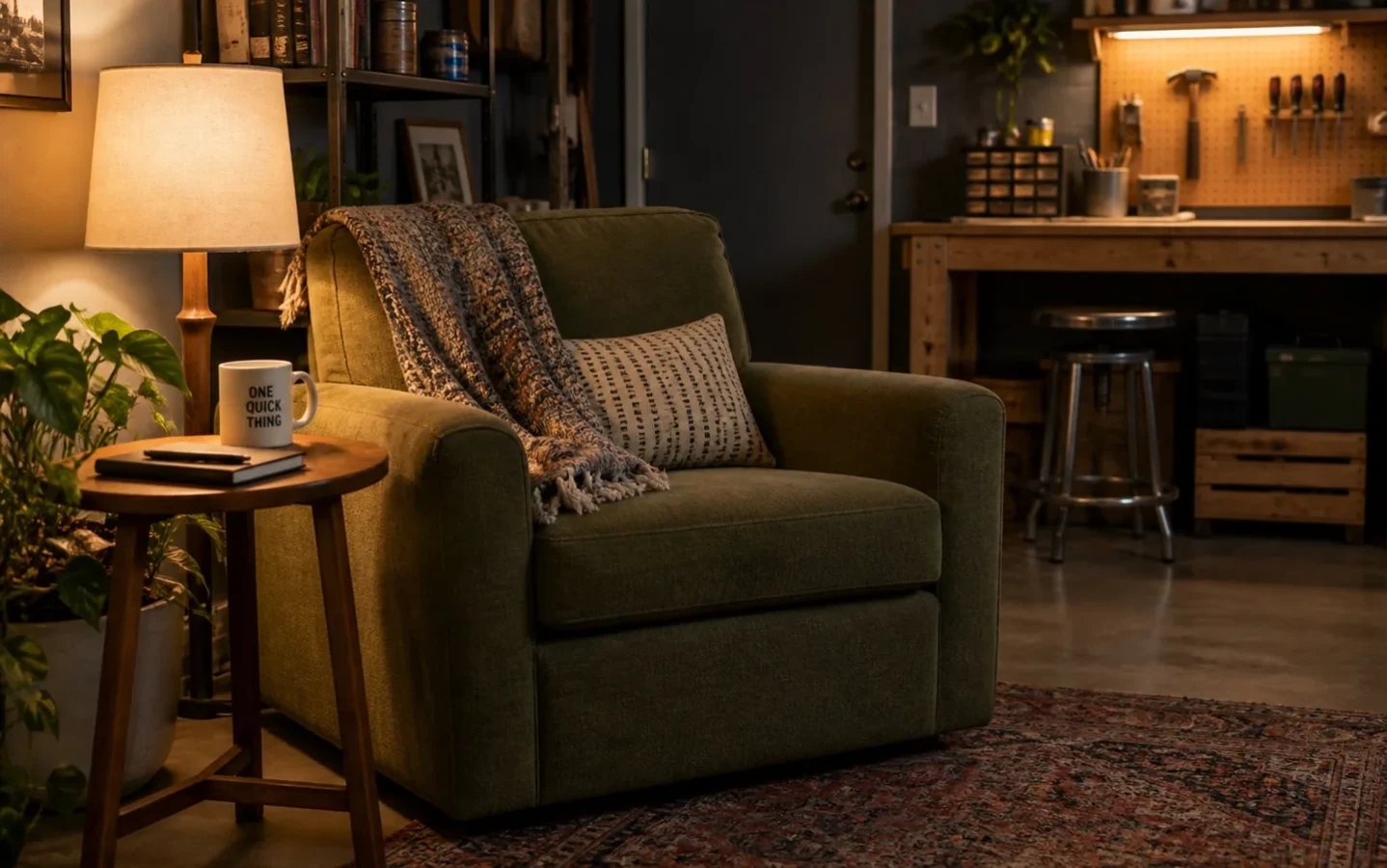
A chair can make a garage more inviting. It can also become a large upholstered reminder that the room still has other jobs. Before making a permanent hangout corner, try a smaller question: can this be a good place to read, and can it return to its other uses without a wrestling match?
This is a planning exercise for an existing space, using ordinary furniture where the conditions are suitable. It is not a completed makeover, a chair review, or an assessment of whether a garage is suitable for occupancy.
Pick an activity with a small footprint
Start with reading, sketching, or listening to music from a device you already use. Describe the activity without building a shopping list around it. Reading might need a seat, an appropriate light, and somewhere for the book and a drink. It does not automatically need a television wall.
Try a chair you already find comfortable. Sit in the actual location with the actual activity. Can you get in and out easily? Does the light serve the page? Is the nearby surface useful from the seat, or merely nearby in floor-plan terms?
Comfort is personal. Record what you notice during your normal session instead of treating the shape of a chair as a promise about how it will feel.
Walk the room with the chair in use
Check the chair's occupied footprint, including how far it moves when someone sits down or gets up. Open the doors and drawers that share the area. Keep exits, equipment access, and the path through the garage available.
Do not place furniture in the travel of a garage door or around its operating equipment. If the only arrangement depends on nobody opening something, keep looking. The layout needs to work with the room you have.
For a temporary trial, you can sketch or mark the intended location before carrying furniture in. The point is to understand the space, not to claim that a drawing verifies clearance or compliance.
Give the furniture an exit plan
Decide where the chair, lamp, and small surface will go when the other work starts. Check that destination now. “Move it somewhere” is not much of a plan once both hands are full.
Prefer items you can move safely and store appropriately. If something is heavy, awkward, or unstable, arrange suitable help or choose a different piece. A folding or wheeled item still needs to be used as its manufacturer intends; portability does not establish stability or suitability.
If you cannot find an appropriate storage destination, reduce the setup. One chair that has a home may serve you better than a sofa that permanently occupies the route to everything else.
Separate downtime from conflicting work
Dusty work, finishing, chemicals, and other potentially hazardous activities require their own controls and instructions. A movable chair does not solve ventilation, fire precautions, contamination, or cleanup. Keep soft furnishings away from incompatible work and address the work itself before treating the space as a hangout.
Never use a generator inside a garage, even with the doors open. Do not use a charcoal grill or a portable gas camp stove indoors. The CDC's carbon-monoxide guidance explains these risks. A warm atmosphere should come from appropriate lighting and a suitable space, not improvised combustion equipment.
If heat, cold, damp, or air quality makes the room unsuitable, pause the furniture plan and get the relevant problem assessed. This article does not design heating, insulation, or a garage conversion.
Let one evening write the brief
After trying an ordinary session in suitable conditions, write three observations: what helped, what interrupted you, and what you had to move afterward. Keep those notes practical. A lamp reflection, an unreachable side table, or an inconvenient storage destination tells you more than a photograph alone.
Change one thing and try again. Add the personal details when the arrangement works: a notebook, a small print, or music at a considerate level. You are allowed to make the space feel like yours before it looks finished.
And when the next project starts, put the reading corner away as planned. Leaving room for both activities is the improvement.
Prove that the corner can leave
Try the seat at the time you normally read. Set down a book and drink, then walk the route from the door with the seat occupied. Afterwards, move the pieces to their intended waiting spot and restore the garage activity. The useful test is the complete changeover, not an attractive photograph of the seat.
Measure the storage footprint as well as the comfortable footprint. Choose a reading light around the page, seated position and glare you actually observe.
Sources
CDC — Carbon Monoxide Poisoning Basics · Checked 2026-09-15.