

The hardest screw to find is often the one that looks almost like the other twenty screws in the same compartment. More storage does not solve that problem until the categories become useful.
Decide whether the parts live at the bench or travel with the job. Then choose a drawer cabinet or a portable organizer around the separation you need. This guide compares the Akro-Mils 10124 and STANLEY SORTMASTER STST14027 using manufacturer information, not hands-on testing. Product links are ordinary links and earn Garage After Hours no commission.
Separate reusable stock from project-specific parts
General stock needs an address you can return to: a drawer or compartment identified by the information that distinguishes its contents. Project-specific parts need their connection to the project preserved, especially when two similar pieces have different jobs.
Keep useful original labels and packaging. Where known, record size, thread specification, material or manufacturer part number. If an unidentified fastener matters to a load-bearing or otherwise safety-critical job, do not guess from appearance. Set it aside until correctly identified or replace it with the specified part.
Try this distinction with one small collection before reorganizing the whole garage. A label reading “M4 × 12 mm machine screws” is useful only if that identification is established. “Unidentified — do not mix” is a perfectly respectable temporary category.
Pick the retrieval pattern
On a narrow screen, swipe the table sideways to see every column.
| Pattern | Candidate format | Main tradeoff |
|---|---|---|
| Take one part, return to the same bench | Drawer cabinet | Many visible addresses, but a cabinet needs a suitable fixed home |
| Take the assortment to the work | Portable compartment case | Parts travel together, but the open lid and whole case need room |
| Keep a few pieces with one unfinished job | Labeled smaller containers inside a project bin | Inexpensive trial; containers still need suitable closure and identification |
This is a choice about retrieval, not another open-versus-lidded-bin decision. Use the existing storage guide for that broader question.
Akro-Mils 10124: many addresses at the bench
The Akro-Mils 10124 is a 24-drawer plastic cabinet. The manufacturer describes clear drawers, finger-grip pulls and rear stops, and lists a 20-inch-wide by 6⅜-inch-deep cabinet. It says a limited number of dividers are molded into the back, with additional dividers available separately.
The reason to consider it is repeated retrieval from one location. Map one drawer to a clear category and leave room for the collection to change. Do not buy it on the assumption that every drawer arrives with all possible divisions.
Check the current drawing or physical cabinet if height is critical: the page's summary says 15.87 inches, while its dimension table says 15 13/16 inches. We have not independently measured it. We also have not established usable internal drawer space, mounting capacity or protection from garage conditions. Follow the cabinet's installation instructions if mounting it; rear stops are not evidence that a loaded cabinet can be transported without spills.
STANLEY STST14027: an assortment that goes with the job
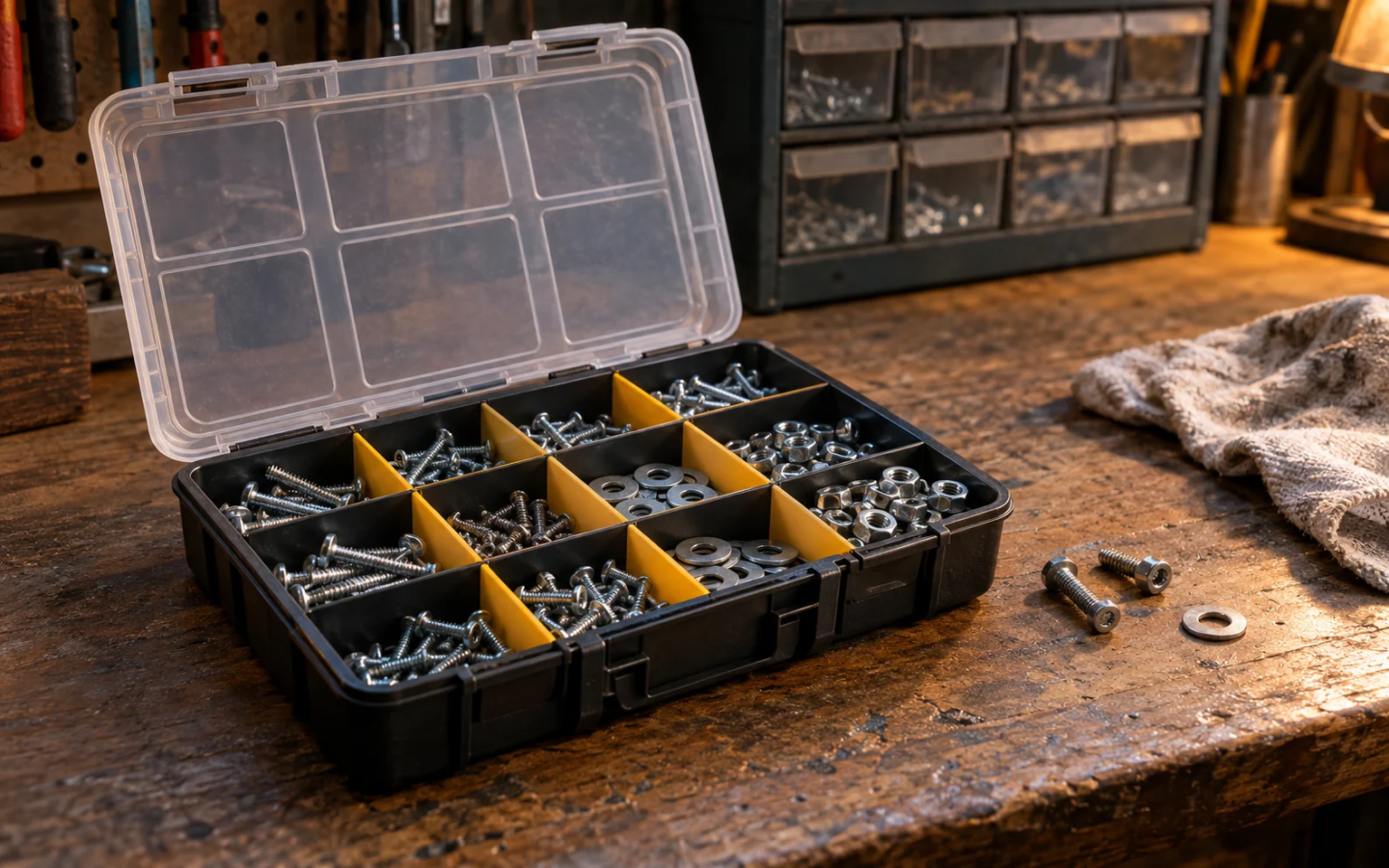
The SORTMASTER STST14027 has removable dividers. STANLEY lists 15 compartments and describes a lid that interlocks with the dividers to reduce movement between compartments. Its side latches are designed to connect units for transport.
Our reason to shortlist it is taking an organized assortment to another work area. The tradeoff is that you need a place for the entire open case. A case buried under two other cases adds retrieval steps even if every compartment is perfectly labeled.
Treat the containment description as a manufacturer claim, not our verification for your smallest washers or a partly emptied layout. Inspect how the dividers seat and how the lid closes with your actual contents. Removing dividers changes the separation. Do not infer a watertight seal, dust rating or compatibility with other storage families from its appearance.
Give the system one return rule
Try a simple rule: each identified part goes back to its labeled address, and uncertain parts go into a separate, clearly marked container for identification. Keep overflow with the same identification rather than quietly mixing it into the next compartment.
Before buying, count the categories you actually have, their quantities and the largest piece in each. A cabinet with more drawers can be less useful if every drawer is too small. A deep case can hide a short supply at the bottom. Consider the part and the hand retrieving it, not only the total compartment count.
For a no-purchase trial, use suitable existing small containers or intact labeled packaging for ordinary dry parts. Keep them together in an appropriate project container. Do not substitute general organizers for the specified storage of batteries, chemicals, sharp items or static-sensitive components.
Try finding one part without emptying everything
After setting up a small section, choose an identified part, retrieve it and put it back. Then repeat from the place where the work actually happens. Notice the search, carrying, opening and return steps. This proposed exercise has no promised time saving; it is a way to find the part of the system that remains annoying.
If the labels fail, improve the labels. If the collection needs to travel, test that workflow. If the problem is too many unidentified leftovers, another organizer will mostly make the uncertainty stackable.
Compare the trip as well as the compartments
Choose one real task and trace where its parts travel. If the work moves away from the bench, test carrying and returning the contents. If the work stays in place, test seeing and retrieving a part without opening every compartment. The helpful question is which arrangement survives that routine.
Before choosing either format, check the largest part in its actual compartment and practice returning it to the same labeled place.
Sources
Akro-Mils — 10124 24-drawer cabinet · Checked September 15, 2026.
STANLEY — SORTMASTER STST14027 · Checked September 15, 2026.