

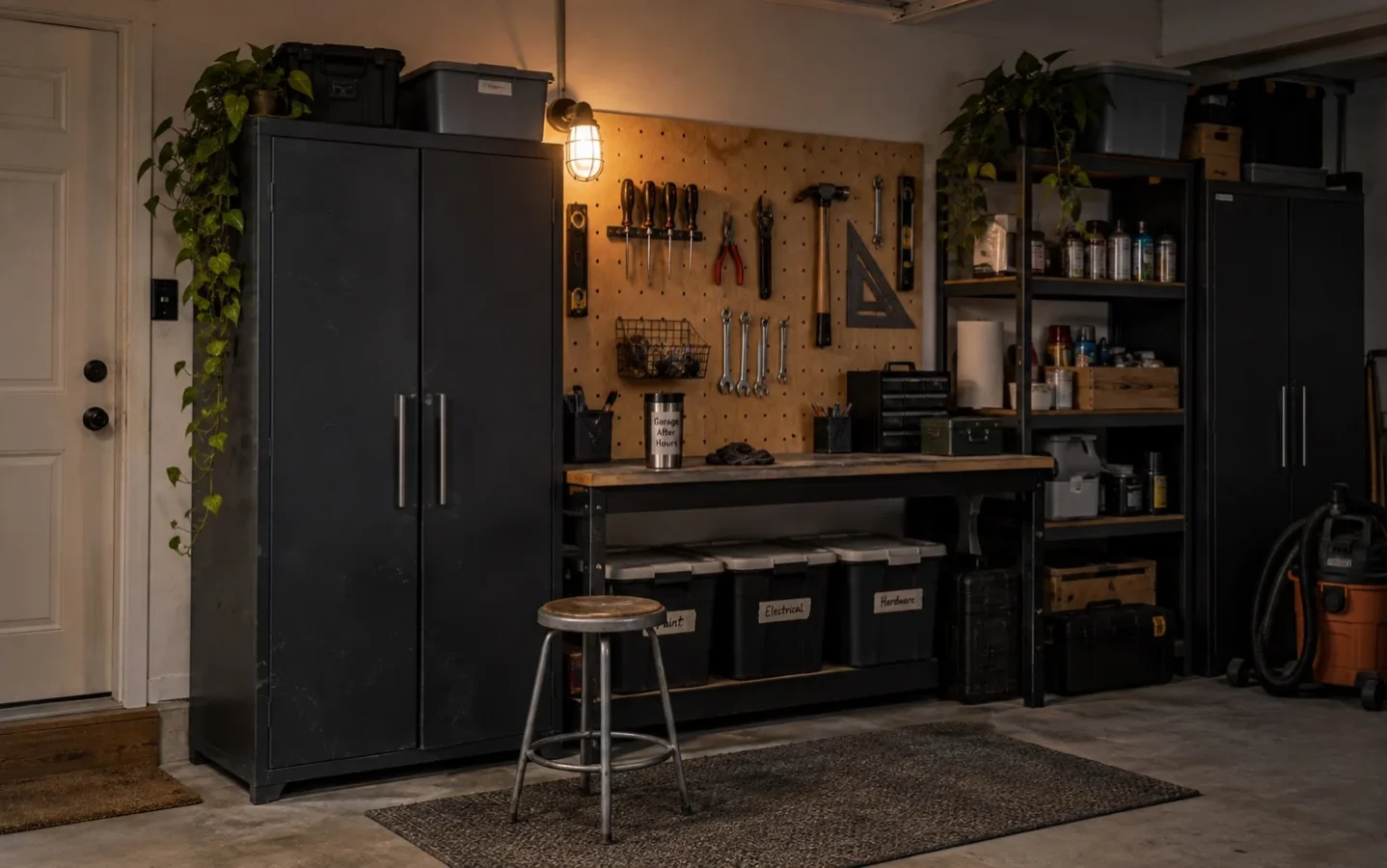
Matching containers can make a garage look settled while leaving every useful item three lids deep. Open storage can solve that annoyance and create another one: everything is now visible, exposed, and very easy to add to without thinking.
Choose storage around the job and the contents. This guide is a decision worksheet for ordinary, nonhazardous project supplies. It does not replace product-specific storage instructions or claim that a particular box protects against dust, moisture, pests, or fire.
Start with the contents that have rules
Set aside anything with its own storage requirements. Chemicals, batteries, sharp items, food, and other sensitive contents need suitable storage, not whichever container matches your shelf. Read the item's instructions before making it part of a mixed activity kit.
This guide deliberately does not pick a universal garage bin. A clear plastic box, a cardboard tray, and a fitted case may all hold objects, but they make different promises. Do not infer a protective rating from the presence of a lid.
Separate active supplies from reserve supplies
Lay out what you reach for during one familiar activity. A drawing setup might need the current paper, a few pencils, and an eraser nearby. The backup paper and the collection of rarely used supplies can live elsewhere. That example is an editorial illustration, not an inventory from someone's garage.
An open container may suit ordinary active supplies when easy access matters and the conditions permit it. A lidded container may be useful when you need to contain loose pieces or put an activity away. Whether it protects the contents depends on its actual design and instructions.
Do not decide with an empty bin. Put the real, appropriate supplies in it and check whether the arrangement still makes sense.
Count the steps in a normal session
Imagine the entire sequence: retrieve the container, set it down, open it, find the contents, work, and put it away. Where does the lid go? Can you open it in place? Must you move a different project first?
If a lid becomes an obstacle every time you reach for an ordinary item, reconsider where the active supplies sit. If the open bin becomes a general dumping ground, reduce its scope and label the activity more clearly. “Sketching — current supplies” is a more useful boundary than “Miscellaneous,” a category with no known natural predators.
The CCOHS housekeeping guide emphasizes planning how materials move through a workspace. That is the general source principle behind checking the whole retrieval-and-return sequence; the examples and choices here are our planning suggestions.
Compare the tradeoffs on your shelf
| Choice | Useful question | Tradeoff to inspect |
|---|---|---|
| Open activity bin | Do I reach into this repeatedly? | Easy access also makes unrelated additions easy |
| Lidded project box | Does the whole activity need to move or wait? | Opening, lid storage, and stacking add steps |
| Original or fitted case | Does the item need its own protection or organization? | The case may use more room but preserve an intended arrangement |
Measure the space a loaded container actually needs, including handles, the lid, and room to reach it. Follow the shelving and container instructions. A stack that fits in a photograph is not evidence that it is stable or appropriate.
Try one, label one, revisit one
Use a suitable container already available and give it a specific job. Put a plain label where you can read it from the approach you normally use. After a few ordinary sessions, note what you searched for, what did not fit, and what kept arriving from another activity.
If the contents changed, change the label or split the activity before ordering more boxes. If nothing caused friction, you may already have the right storage. The matching set can survive without you.
Choose after one complete put-away
Try one activity from opening the container to putting it away. Check whether loose parts escape, whether you can see what is inside, and whether the container belongs near the work or farther away. A lid helps only when it protects something that needs protection; an open bin helps only when easy access improves the session.
Check the exact lid and usable dimensions of the container you are considering. A similar-looking box may not close or retrieve the same way.
Sources
CCOHS — Workplace Housekeeping: Basic Guide · Checked 2026-09-15.
For the size question, try the bin and shelf measurement checker. It checks the project inside the bin and the closed bin on its shelf separately.