

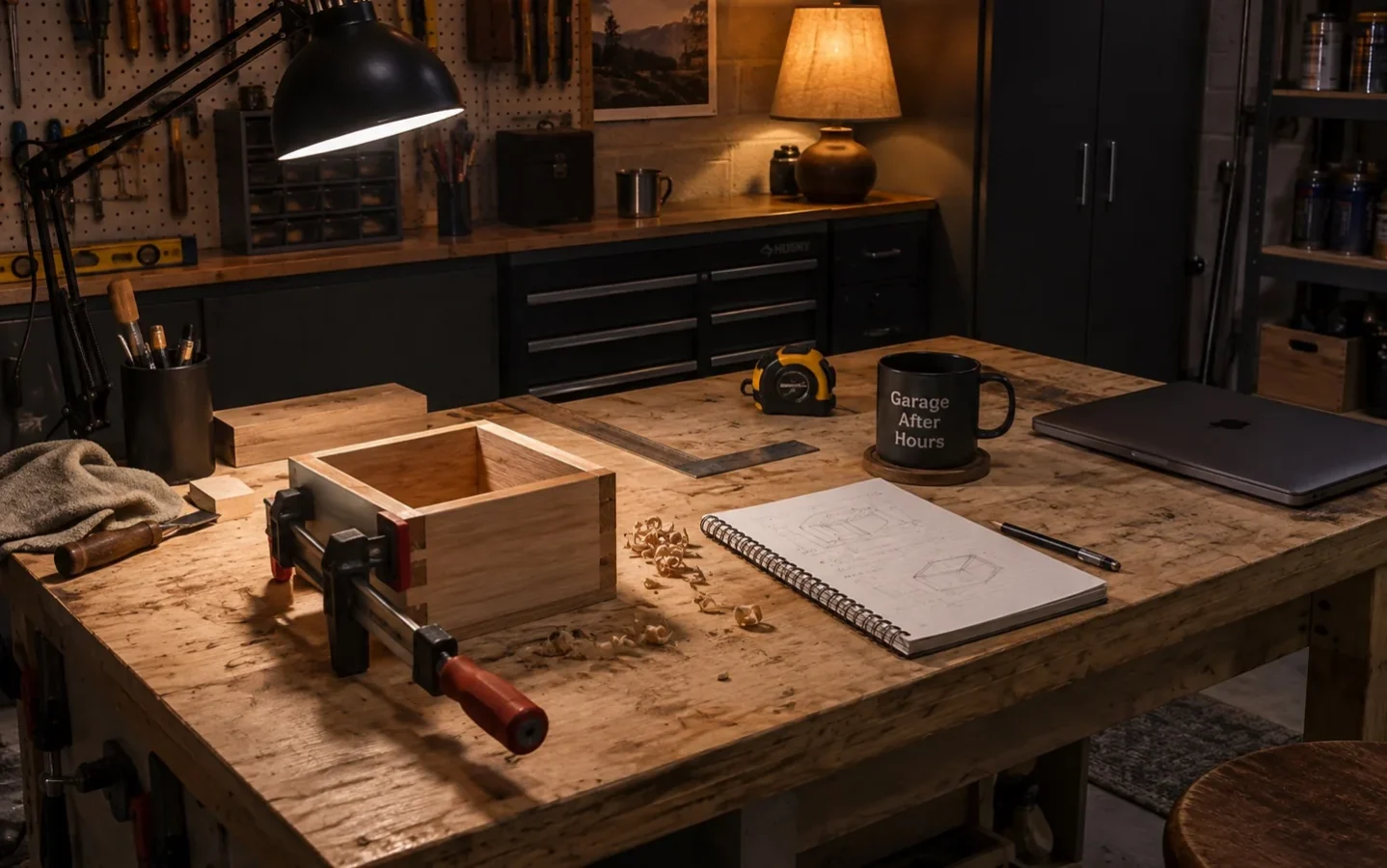
The problem with an unfinished project is often not the project. It is the small negotiation that happens every time you want to use the workbench for something else. Do you pack everything away, leave the whole bench occupied, or move the pieces into a box and hope tomorrow's version of you remembers what happened?
A project parking spot offers a fourth choice: a deliberate place for one paused activity, with its next step still intelligible. This is a planning method for small, ordinary hobby materials. It is not a storage specification for chemicals, batteries, sharp equipment, or an assembled machine.
Decide what needs to stay together
Choose one current project. Separate its active pieces, instructions, and notes from the general tools you use on many jobs. A tool that has a normal storage location can usually return there. The unfinished arrangement is what needs the parking space.
For a paper model, that might mean the current parts and a marked instruction sheet. For a sketching session, it could be the working page and the reference notes. These are illustrative examples, not projects we claim to have built or tested.
The question is not “How large a bin can I fit?” It is “What would I have to reconstruct if I put this away?” Keep that information with the project.
Choose the destination before the container
Identify a place where the project can wait without taking over an exit, an access route, or another activity's work surface. Check the actual footprint, how you will reach it, and how you will move the contents. A tray that slides onto a shelf is useful only if that shelf and the tray are suitable for the load.
The CCOHS housekeeping guide treats orderly material storage and clear work areas as continuing practices. We use that general principle here, without making a load-rating or safety-compliance claim for your furniture.
Try a suitable container you already own before buying a set. Do not stack a delicate, awkward, or unstable project just because the containers happen to nest. Keep materials with special storage instructions in their specified storage.
Leave a restart note
Write three short lines: what this is, where you stopped, and the next useful action. Be specific enough that the note will make sense after a busy week. “Continue” is optimistic. “Check the fit of the two paper panels before attaching them” is helpful.
Include the name or location of any instructions you need. If orientation matters, a simple sketch may be clearer than a paragraph. Do not put private account details or unrelated household information in a shared project note.
A restart note is also a useful place to record uncertainty. “Need to check the instructions before the next step” is better than confidently repeating a guess.
Practice the whole move
Before relying on the setup, try putting the project away and taking it out again. Can you do that without unloading unrelated boxes? Does the container sit securely while you open it? Is there room to set things down before you need both hands?
If moving the project takes as much rearranging as starting it from scratch, simplify. You might need a smaller active stage, a nearer destination, or a different project footprint. You may also discover that this particular project needs a dedicated space. That is useful information before buying a cart.
Set an honest limit
One parking spot does not automatically justify six more unfinished projects. Choose how many paused activities the available space can reasonably hold. When it fills, review what is there before adding storage.
Use a plain decision: continue, put into appropriate longer-term storage, or stop. Stopping a project is allowed. The garage is not an evidence locker for every idea you have ever had.
End with a place to begin
Return shared tools, remove unrelated material, park the project, and leave the next starting surface usable. On your next session, notice which part of restarting was awkward. Change that part of the arrangement.
The goal is not a permanently empty bench. It is a bench you can use again without losing the thread of what you were making.
Give the parking spot a return test
After one session, put every loose part of the paused project in its planned spot and leave a one-line restart note. On the next session, retrieve it without clearing an unrelated activity. If the project cannot leave and return without a search, change the spot or containment before buying another organizer.
Measure the largest unfinished piece, not the average part. Try an existing tray or container and check that you can move the whole project without disturbing its arrangement.
Sources
CCOHS — Workplace Housekeeping: Basic Guide · Checked 2026-09-15.
Before choosing a container, use the project-bin and shelf fit checker to record the project envelope, usable inside space and shelf opening.