

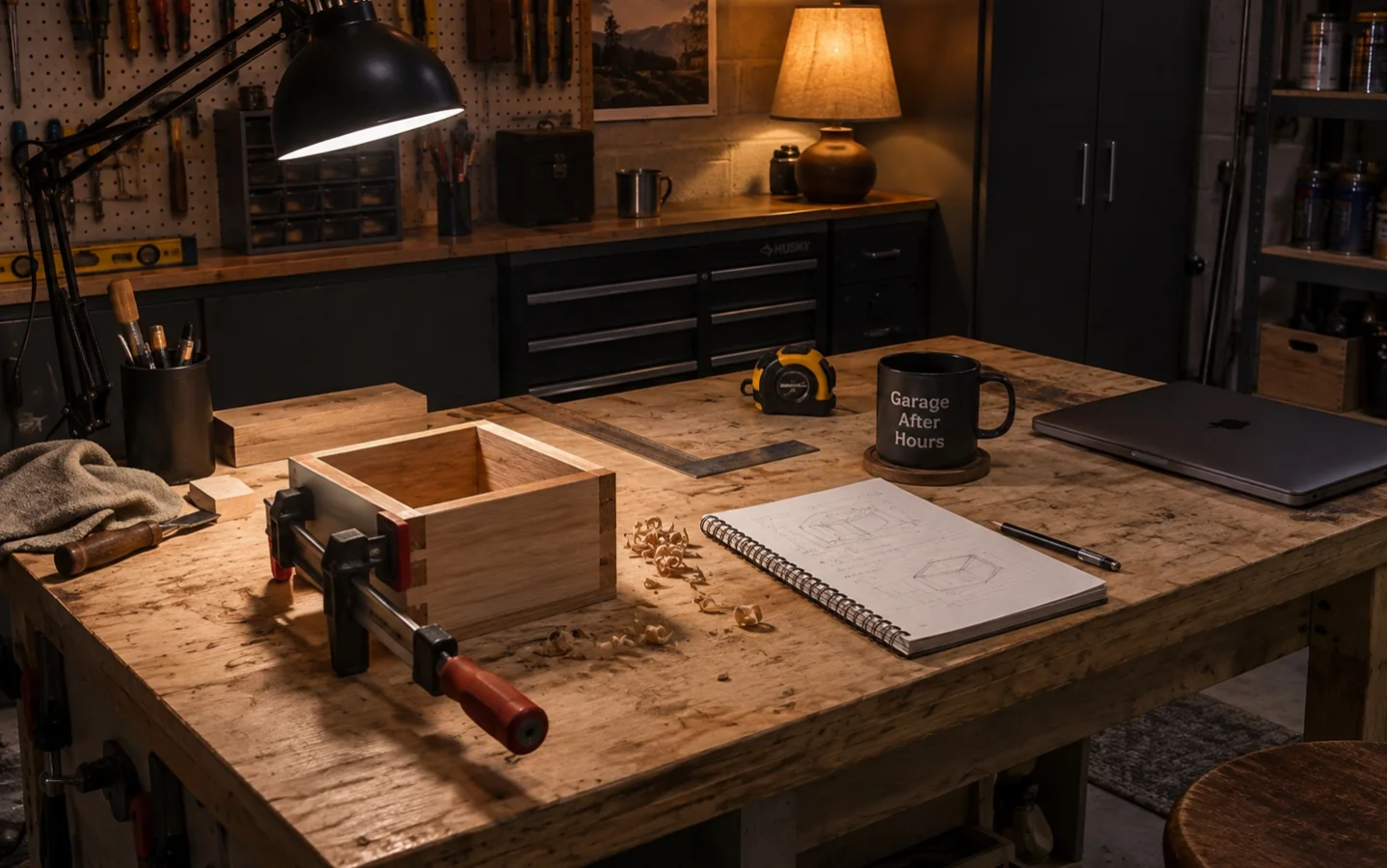
A bright garage can still have a badly lit workbench. Stand between the ceiling light and a small project and the important part may disappear into your own shadow. Add a shiny screen, a pale tabletop, and a lamp pointed toward your face, and buying more light becomes a surprisingly indirect solution.
Start with one ordinary task in the place you actually do it. This guide offers a way to describe the problem and try a better arrangement. It is researched planning advice, without a hands-on lamp comparison or a promised brightness target for your room.
Name the problem at the work surface
Put your usual project, notebook, or laptop in position. Sit or stand where you normally work. Look for three different annoyances: a shadow over the thing you need to see, a bright reflection on its surface, or a bare light source in your line of sight. Write down which one interrupts you. “Bad lighting” is too broad to help you choose the next move.
The Canadian Centre for Occupational Health and Safety separates insufficient illumination, glare, contrast, uneven distribution, and flicker in its lighting survey guidance. Those categories are useful vocabulary here; this small trial is not a workplace lighting assessment.
If the light flickers, a fitting is damaged, or anything seems electrically wrong, stop using the affected equipment and address that fault. Rearranging a desk is not a repair.
Try placement before output
Use an existing, suitable adjustable lamp if you have one. Follow its mounting and bulb instructions, keep its base or clamp stable, and keep the cord out of your walking route. With the lamp switched off and cool when necessary, try a position beside the work, then check the result from your working position.
Move one thing at a time. Check whether your hand blocks the beam when you actually write or assemble something. Then look up: is the lamp now shining into your eyes? The useful position is the one that serves the activity, not the one that photographs most dramatically.
For a screen, inspect the dark parts of the display for reflections before changing brightness settings. Try changing the relative position of screen and lamp. CCOHS discusses repositioning lights and work surfaces to reduce glare; it does not prescribe one universal lamp position for every user and task.
Read the label without turning it into a room plan
Lumens describe a lamp's light output; watts describe its power input. Light appearance is a separate characteristic, commonly expressed as color temperature. The Department of Energy's bulb guidance explains these distinctions.
The lumen number alone does not tell you how much useful light reaches your particular bench. Placement, distance, shade, surrounding surfaces, and the task still matter. We are not converting your floor area into an invented fixture schedule.
If you decide to shop, copy the relevant limits from your fixture's instructions first. Check bulb base, allowed type and rating, dimmer compatibility where relevant, and permitted operating conditions. A garage that gets damp or very hot may fall outside an ordinary indoor lamp's instructions. New wiring or uncertainty about the installation belongs with a qualified electrician.
Give task light and atmosphere separate jobs
You can prefer a warm corner without expecting one decorative lamp to handle every detail of a hobby. Keep a useful task light available and treat the background lamp as a separate choice. Compare both from the seat you actually use.
Try this simple note after an ordinary session: “I could see the work, but the light reflected in the screen when I turned toward it.” That describes a decision. “Needs better vibes” mostly describes another evening of browsing.
Keep a small comparison record
| Observation | First thing to try | What to check afterward |
|---|---|---|
| Your hand shadows the work | Move a suitable task lamp to another position | Visibility during the actual movement |
| A reflection covers the screen | Change the relative lamp and screen position | The display from your usual seat |
| The room feels harsh during downtime | Use a separate background-light setting | Working and walking areas remain usable |
Record the arrangement that works, including where the lamp sits and what activity you tried. If you still need a purchase, you now have a short specification. Start there, rather than replacing every fixture because one corner is annoying.
Write a light buying brief from the trial
Try your existing light at the actual surface, then look from the position where you work. Keep a note of the shadow, reflection or dark patch that remains. A light that feels bright while standing at the door can still put a reflection in the thing you need to see. Repeat the check in the evening you intend to use the garage.
If the remaining problem is broad room coverage, the separate Feit option below is worth comparing. It does not replace an adjustable task lamp or solve unsuitable wiring. Check the exact model instructions, outlet and garage-door movement.
As an Amazon Associate I earn from qualifying purchases. We may earn a commission if you buy through the optional product links.
Check current prices on Amazon. No item-price estimate or total is quoted here. Allow separately for quantity, delivery, tax, mounting supplies and any qualified help.
Sources
CCOHS — Lighting Ergonomics: Survey and Solutions · Checked 2026-09-15.
US Department of Energy — Purchasing Energy-Efficient Light Bulbs · Checked 2026-09-15.