

PROJECT → BIN → SHELF

Will it fit in the bin?
Will the bin fit on the shelf?

Check both before you buy storage. Measure your packed project, the bin’s inside and outside, and its shelf space.

For example: a paper-model kit may fit inside a box, but the closed box can still be too tall for its shelf. This checker catches either problem.
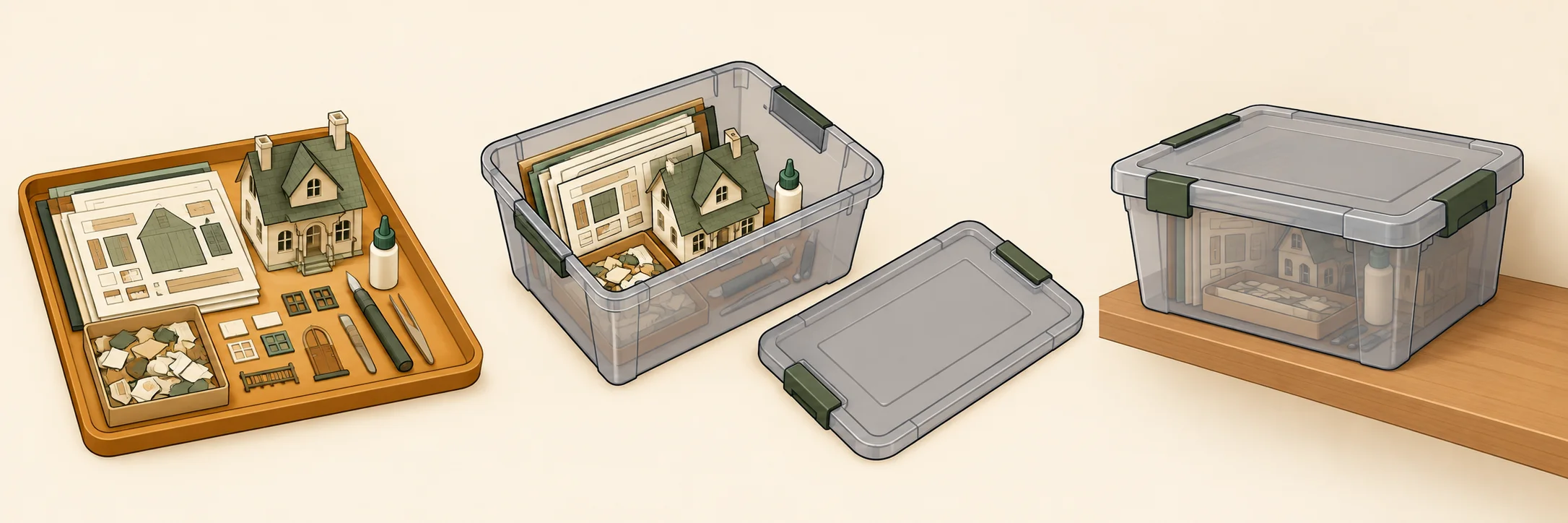
Illustrative sequence: a paper-model kit on a tray, the kit inside a bin, and the closed bin on a shelf.
1 · Your project What needs to stay together2 · Your bin Inside for the project; outside for the shelf3 · Your shelf The clear space the bin can occupy

AI-generated teaching illustrations. Fictional objects, not product specifications.

Try it with a sample.

Fictional paper-model kit: 9 × 6 × 3 in. No real product dimensions are supplied.

Enter your measurements, or load an example.

Enter decimals: 7.5 means 7½. Width is left to right; depth is front to back; height is bottom to top.

STEP 1 OF 3

Measure the whole project.

Group the parts as you want to store them, including their tray or protective packaging. Measure the smallest rectangular space around the whole group—not just one piece.

STEP 2 OF 3

Measure the bin twice.

Inside tells us whether your project can go in. Outside tells us whether the closed bin can go on the shelf. These numbers are different.

The same fictional bin shown open with its inside cavity highlighted, then closed with its outer rim and handles visible.
OPEN · Measure usable inside spaceCLOSED · Measure largest outside size

STEP 3 OF 3

Measure its shelf space.

Measure the clear opening, the supported depth and the space up to the shelf above. Do not use the cabinet’s overall dimensions.

Extra room & turning options

Extra room means space you want left over. If a kit is 9 in wide and you ask for 0.5 in extra, it needs 9.5 in of usable inside width. The 0.5 in is the total—not 0.5 in on each side.

Zero means no extra allowance. Choose room for protection, hands and handling by trying the real setup. These numbers do not check a lid’s opening swing.

Turning swaps width and depth. Height stays upright. No tipping, diagonal fitting or stacking.

W × D × HD × W × H

A dimensional check, then a real-world trial.

Measure the bin’s narrowest usable inside space under its closed lid. Tapered walls, corners, handles and rims can make a listed outside dimension misleading. Keep width and depth in the same orientation when measuring the inside and outside.

This compares rectangular spaces. It does not arrange loose objects, check a carrying route, validate a shelf’s load capacity or establish safe storage. Try one bin with the actual project and follow the container and shelf instructions before buying multiples.